


Restaurant & Food Service Insurance in Southwest Florida
What actually goes wrong in a restaurant
01
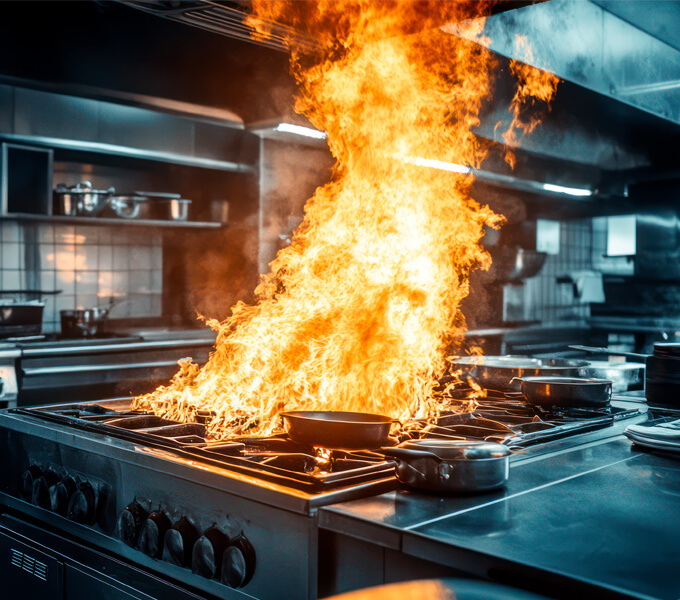
The hood fire takes the kitchen and then the season.
Grease fires are the most common serious restaurant loss and rarely stay in the hood. The building damage is the smaller problem. The larger one is the eight or twelve weeks you are closed while a contractor waits on a hood system, and whether your business income limit was set on a slow August or a busy February.
02
The power goes out and the walk-in warms up.
A cooler full of protein is real money. Standard commercial property does not automatically pay for spoilage, and it usually will not respond at all to a power failure that happened somewhere else on the grid unless you carry a utility services or off-premises power endorsement. This is one of the most common gaps we find on a restaurant's declarations page in this market.
03
Somebody leaves your bar and causes a wreck.
Florida limits when a business can be held liable for serving alcohol, but "limited" is not "never," and defense costs arrive whether or not you eventually win. Your landlord, your distributor and your liquor license may all require liquor liability regardless. General liability policies routinely exclude it outright.
04
A guest gets sick and names you publicly.
Food-borne illness claims bring three costs at once: the claim, the health department, and the online reviews. Some policies include a limited food contamination or communicable disease extension that also pays for cleanup, product replacement and reputational expense. Most do not include it unless somebody asked.
05
An employee sues over hours, tips or a manager.
Restaurants generate more employment practices claims per employee than almost any other class — wage and hour, harassment, wrongful termination. EPLI is a separate policy or endorsement, and it is the coverage restaurant owners most often discover they do not have on the day they need it.
06
Your delivery driver hits somebody in their own car.
If your staff runs food, runs to the restaurant supply store, or makes a bank deposit in a personal vehicle, your commercial auto policy needs hired and non-owned coverage. Their personal policy will likely exclude the trip because it was business use.
What a restaurant's program looks like
The foundation
General liability
Slip and fall, guest injury, property damage. Confirm what the assault and battery language says; many restaurant and bar policies sublimit or exclude it entirely.
Commercial property
Building if you own it, plus contents, kitchen equipment, and the tenant improvements and betterments you paid for. Those improvements are yours to insure even though the landlord owns the walls.
Workers' compensation
Burns, cuts, slips and back injuries. Florida's requirement for a non-construction business generally begins at four employees, counting part-time.
Commercial auto
Catering vans, delivery vehicles, and hired and non-owned for personal cars used on restaurant business.
Commercial umbrella
Extra liability limits. Landlords in the better retail centers increasingly require it in the lease.
What gets added on top
- Liquor liability — separate from general liability, which excludes it. Required by most landlords and many distributors
- Business income and extra expense — the coverage that actually decides whether you reopen. See the seasonality note below
- Spoilage and equipment breakdown — the walk-in, the ice machine, the HVAC. Breakdown covers the machine, spoilage covers what was inside it
- Utility services / off-premises power — responds when the outage happened at the utility rather than at your building
- Food contamination and communicable disease — cleanup, restocking, lost income and sometimes reputation expense after a health department event
- Employment practices liability (EPLI) — the highest-frequency exposure in this industry
- Cyber liability — you take cards, you run a POS, and you probably hold a customer email list
- Sign coverage — often sublimited to a number far below what your sign cost
What makes this harder in Florida
01
Your income limit has to be set on your season, not your average.
02
Hurricane closure without damage is usually not a claim.
This is the hardest conversation in this industry and it is better to have it in August than in September. Business income coverage generally requires direct physical damage to your property. An evacuation order, a closed bridge, or a week with no tourists after a storm that missed you may not trigger it. Civil authority coverage helps in narrow circumstances and has its own conditions and time limits. Know what yours says before the season starts.
03
Named-storm deductibles are a percentage, not a dollar amount.
On a build-out and equipment package insured for five hundred thousand dollars, a five percent named-storm deductible is twenty-five thousand out of pocket. Know your number.
04
Your hood cleaning records are underwriting.
Carriers in this market ask how often the hood and duct system is cleaned and by whom, and they price on the answer. Keeping the invoices is worth money at renewal and worth considerably more at claim time.
What we need to quote it
No cost, no obligation. If your current program is already doing its job we will tell you that.
Current declarations pages for every policy
Loss runs, five years or as many as you have
Annual sales, split between food and alcohol
Seating count, hours of operation, and whether you have live entertainment or late-night hours
Square footage and whether you own or lease, plus a copy of the lease insurance requirements
Annual payroll and employee count
Hood and duct cleaning schedule and vendor
Whether you deliver, cater off-site, or run a food truck
Vehicle schedule if you own any

Restaurant insurance questions
More commercial questions are answered on our business FAQs page.
Send us your declarations pages. We will tell you what is missing.
Three offices, one commercial team. We have insured Southwest Florida restaurants since 1982, through hurricanes, closures and more than one rebuild.